-
Kitchen Knives
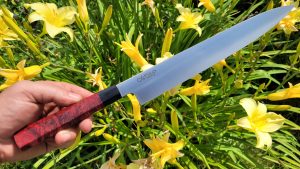
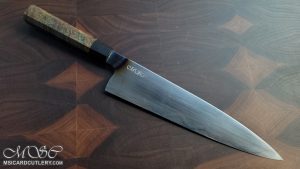
270mm MagnaCut Sujihiki
$610.00Prices are Tariff Inclusive
A 270mm MagnaCut Sujihiki
This 270mm MagnaCut sujihiki is one of only a few stainless sujihikis I’ve ever made and one of only 3 I’ve made with MagnaCut. The handle consists of buffalo horn and stabilized maple burl. The choil and spine are nicely rounded and polished to 600 grit.
Blade Details
Blade: 274mmx38mm MagnaCut (~63hrc) with belt finish
Neck: 17mmx16mm
Handle: Horn and stabilized maple burl, oil finished, buffed and waxed
POB: 55mm from the handle
Spine: 2.65mm at the handle, 2.55mm at halfway, .91mm 1cm from the tip
Grind: full convex 50/50
Weight: 178g
Relieved choil and spine.
Edge: .27mm@1mm, .39mm@2mm from the edge, measured at the midpoint
Blade Special Features
Fully convex ground blade
To learn more about MagnaCut steel click here: https://knifesteelnerds.com/2021/03/25/cpm-magnacut/
For the maker’s summative take on MagnaCut click here: https://msicardcutlery.com/knife-making-steel-information-faq/
-
Kitchen Knives
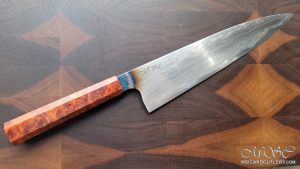
165mm M2 HSS Petty
$400.00Prices are Tariff Inclusive
A 165mm M2 HSS petty
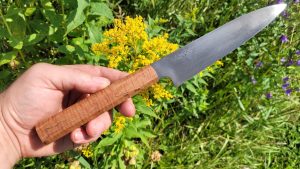
This 165mm M2 HSS petty is my first offering in this particular steel. It was forged down from a broken industrial planer blade once used by my father’s previous business.
Blade Details
Blade: 165mm X 35mm M2 HSS (~64 HRC) etched to reveal banding
Neck: 18mmx10mm
Handle: Stabilized AAAA curly maple
POB: at the handle
Spine: 1.88mm at the handle, 1.6mm at halfway, .61mm 1cm from the tip
Grind: full convex 50/50
Weight: 92g
Relieved choil and spine.
Edge: .16mm@1mm, .26mm@2mm from the edge, measured at the midpoint
Blade Special Features
Fully convex ground blade
To learn more about knife steels click here: https://knifesteelnerds.com/2021/10/19/knife-steels-rated-by-a-metallurgist-toughness-edge-retention-and-corrosion-resistance/
For the maker’s summative take on various steels click here: https://msicardcutlery.com/knife-making-steel-information-faq/
-
Kitchen Knives
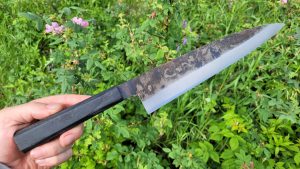
Forged Banding 200mm D2 Gyuto
$900.00D2 Tool Steel Is Tariff Free And Falls under CUSMA.
A forged D2 gyuto with banding
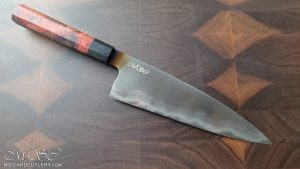
This is a special knife utilizing materials I’ve never used previously. In the past I’ve made forged blades of differing varieties that have been etched and polished to reveal the alloy banding within the steel. This is one such blade but in a steel I had previously never worked with, ingot D2 tool steel. Surprisingly this D2 gyuto was less difficult to make than I had anticipated, though still much more difficult than any low alloy steel or A2.
The banding is phenomenally dense and photographing it was a nightmare as the pictures tended to look bland and grainy. There’s just too much detail for a nice macro shot. So while it looks a bit bland and 2D, every white line in actuality represents a bit of figuring that dances in the light as you look over the blade. Next time I forge a D2 gyuto I’ll try to make the activity a bit bolder but I didn’t want to push my luck with this stuff, never having forged it previously.
I also thought I’d try something new for the handle and used a piece of wenge end grain that has a lovely bit of character only occasionally seen on knife handles. It appears lighter than it actually is in the pictures. This D2 gyuto’s banding just refused to be photographed without otherwise excessive exposure.
- Blade: 203mmx57mm Forged D2-Tool Steel 800 grit diamond lapping film finish + etch and polishing cycles
- Neck: 18mmx18mm
- Handle: Wenge endgrain, oil finished and waxed
- POB: 30mm from the handle
- Spine: 2.7mm at the handle, 2.1mm at halfway, .59mm 1cm from the tip
- Grind: full convex
- Weight: 165g
- Relieved choil and spine
- Edge: .17mm@1mm, .32mm @2mm, measured at the midpoint,
To learn more about D2 tool steel click Here
For the makers summative take on various steels click Here
-
Kitchen Knives
250mm ProCut San-Mai Gyuto
$50.00A 250mm ProCut san mai gyuto
I’ve been sitting on this one for a while and finally have it done. This 250mm ProCut gyuto is similar to a shorter blade I put out in February of this year (posted HERE) and features the same kind of complex grind geometry and stonework.
- Blade: 250mmx57mm ProCut/mild san-mai (64/65hrc) -stone set bevels + 2500 grit hand finish + etch and polish
- Neck: 19mmx19mm
- Handle: Wenge mono, oil finished and waxed
- POB: 66mm from the handle
- Spine: 3.94mm at the handle, 3.25mm at halfway, .78mm 1cm from the tip
- Grind: full convex zero grind
- Weight: 252g
- Relieved choil and spine
- Edge: .10mm@1mm, .23mm @2mm, 1.65mm at the shinogi measured at the midpoint,
As you can see the banding isn’t quite as prominent in this blade despite using the ame cladding material. I suspect this is due to the higher austenitizing temperature I used for ProCut vs the SheffCut in the last one. Nonetheless it has a distinct pattern in the cladding that I only wish I could highlight more.
*The cladding does indeed get close to the edge but at no point touches it
Any US Tariffs will be prepaid by myself in full.
To learn more about ProCut steel click here: https://knifesteelnerds.com/2025/06/04/pops-procut-a-new-carbon-steel-for-knives/
-
Kitchen Knives
230mm Forged Low Bevel Gyuto (26c3)
$450.00A 230mm forged 26c3 san mai gyuto
My forging experiments continue and while I’m getting close to where I want to be, I’ve determined I need better dies to take me the rest of the way. This 230mm forged blade is like the previous ones, and once again I did no go to the extent of taking out all of the grinder marks as it was primarily built as a tool to learn on. The edge geometry is perhaps the thinnest I have ever made and the knife cuts beautifully.
- Blade: 232mmx60mm 26c3/mild san-mai (64/65hrc) -stone set bevels + 2500 grit hand finish + finger stone kasumi polish
- Neck: 18mmx19mm
- Handle: Bolivian Rosewood mono, oil finished and waxed
- POB: 62mm from the handle
- Spine: 2.94mm at the handle, 2.21mm at halfway, 1.32mm 1cm from the tip
- Grind: full convex low bevel 50/50
- Weight: 225g
- Relieved choil and spine
- Edge: .10mm@1mm, .23mm @2mm, 1.65mm at the shinogi measured at the midpoint,
Any US Tariffs will be covered by myself in full.
For the maker’s summative take on 26c3 steel click: Here
To learn more about 26c3 steel click Here
-
Kitchen Knives
MSC X Rockchop 215mm Mizu Honyaki Gyuto
$50.00This is the second of my collaborations with Steve of Rockchop Knife Co.
Some of you may recall my previous mizu honyaki collaborations with Julien Labelle and these are in the same vein. Julien, much to my dismay elected to cease taking on honyaki polishing projects some time ago due to the time commitment and the associated stress, which is why there haven’t been any in some time. You can perhaps imagine my surprise and delight when I reached out to Steve to ask if he might be interested in doing similar collaborations, and he replied by saying that not only was he familiar with my collaborations with Julien, but that he and Julien were acquainted and he had received some tips an instruction from Julien on polishing honyaki!
If you haven’t heard of Rockchop, and aren’t familiar with Steve’ skills, you really ought to check his work out Here. He truly is among the best of the knife sharpeners and polishers active today, a true genius in the making.
This second knife is a gyuto, 217mm X 52mm X 2.6mm and 138g in weight (handle incl.). The handle is one of my Bolivian Rosewood and Peruvian walnut combo handles. The blade is a W2 tool steel mizu honyaki. It has a full convex grind, distal taper, and 14000 grit mirror finish etched and polished to reveal the hamon and the ashi.
To learn more about W2 tool steel click: Here
Thanks for looking!
-
Kitchen Knives
210mm 26c3 San-Mai (Left Hand Bias) Gyuto
$700.00A 210mm 26c3 san mai gyuto
Here’s a potentially interesting blade. This 210mm 26c3 gyuto is my first full migaki polish on a san mai blade forged with my power hammer. I went with AEBL as the cladding hoping that it can serve as an adequately stainless substitute for the near impossible to attain 410 and 420 steels that are ideally used for SS clad carbon steel. It seems to do fairly well rust wise but is certainly less corrosion resistant than the 4xx series. I was also hoping for some interesting banding, but alas after about 12 hours of different polishes and etches I couldn’t come up with a satisfying result so I dropped down to a more functional 600 grit finish. The blade carries the first dedicated left hand biased grind that I’ve made in a while and it has excellent food release on that side.
- Blade: 211mmx56mm 26c3/AEBL san-mai (64/65hrc) 600 grit hand finish
- Neck: 20mmx18mm
- Handle: Cocobolo+walnut, oil finished and waxed
- POB: 30mm from the handle
- Spine: 3.16mm at the handle, 2.04mm at halfway, .51mm 1cm from the tip
- Grind: full convex left hand bias
- Weight: 160g
- Relieved choil and spine
- Edge: .2mm@1mm, .37mm @2mm, measured at the midpoint,
For the maker’s summative take on 26c3 steel click: Here
To learn more about 26c3 steel click Here
-
Kitchen Knives
170mm 26c3 Bunka
$500.00A 170mm 26c3 san mai bunka
- Blade: 170mmx55mm 26c3/mild san-mai (64/65hrc) -stone set bevels + 2500 grit hand finish + finger stone kasumi polish
- Neck: 18mmx18mm
- Handle: Bolivian Rosewood +walnut, oil finished and waxed
- POB: 35mm from the handle
- Spine: 3.1mm at the handle, 3.5mm above the heel, 2.3mm at halfway, 1.61mm 1cm from the tip
- Grind: full convex low bevel 50/50
- Weight: 186g
- Relieved choil and spine
- Edge: ..2mm@1mm, .46mm @2mm, 1.75mm at the shinogi measured at the midpoint,
For the maker’s summative take on 26c3 steel click: Here
To learn more about 26c3 steel click Here
-
Kitchen Knives
180m Low Bevel Bunka 26c3 San-Mai
$500.00A 180mm low bevel bunka in 26c3 san mai.
This 180mm low bevel bunka represents the first forging I performed with my new power hammer and my first shot at forged hollow bevels. Overall it came out well but I’m confident I can get things much thinner with a better set of dies. The blade has been tested and it’s as you would expect with these dimensions, it handles like a workhorse and has excellent food release with no stiction. It does require a little bit more force in denser produce but nothing that feels like work.
- Blade: 183mmx51mm 26c3/mild san-mai (64/65hrc) -stone set bevels + 2500 grit hand finish + finger stone kasumi polish
- Neck: 17mmx16mm
- Handle: Red Zebrawood +walnut, oil finished and waxed
- POB: 38mm from the handle
- Spine: 5.4mm at the handle, 5.2mm above the heel, 2.4mm at halfway, 1.98mm 1cm from the tip
- Grind: full convex low bevel 50/50
- Weight: 200g
- Relieved choil and spine
- Edge: .16mm@1mm, .54mm @2mm, 1.74mm at the shinogi measured at the midpoint,
For the maker’s summative take on 26c3 steel click: Here
To learn more about 26c3 steel click Here
-
Kitchen Knives
160mm 26c3 San-Mai Santoku
$466.00A 160mm 26c3 san-mai santoku
It’s been a while since I posted any new work, it’s been a crazy month and among other things I now have a power hammer in my shop that I’ve been learning how to use. This 160mm 26c3 san-mai santoku is the first of those forged blades to be made available and others will be posted in the coming days. The blade has stone set bevels with good convexity, and while I didn’t go nuts removing every single grinder scratch from the blade 98% of them are gone. Initially I tried a coticule kasumi on one side and got some scratching so I swapped to my uchigumori finger stones to a much better effect and that’s what I’ll stick with from here on out.
- Blade: 160mmx56mm 26c3/mild san-mai (64/65hrc) – stone set bevels + 2500 grit hand finish + finger stone kasumi polish
- Neck: 18mmx19mm
- Handle: Cocobolo+walnut, oil finished and waxed
- POB: 32mm from the handle
- Spine: 2.9mm at the handle, 1.96mm at halfway, 1.65mm 1cm from the tip
- Grind: full convex high bevel 50/5
- Weight: 165g
- Relieved choil and spine
- Edge: .15mm@1mm, .33mm @2mm, 1.7mm at the shinogi measured at the midpoint,
For the maker’s summative take on 26c3 steel click: Here
To learn more about 26c3 steel click Here
-
Uncategorized
Type XVII Longsword
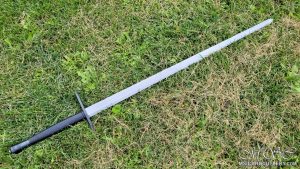
$1,155.00This Oakeshott Type XVII is my very first European style sword, hopefully the first of many. This sword took some real time and effort to make as every component was fit and finished by hand. This blade probably has in excess of 35 hours of labour into it, much of that spent on guard and pommel fitment.
The Type XVII was a historically prominent but lesser replicated sword with widely varying weights and dimensions. While generally conceived of as a thrust centric blade its profile lends itself well to powerful cutting and the geometry makes it somewhat more damage resistant than flattened diamond cross section blades.
Type XVII Features
Blade: 35-5/8″ (90cm) x 1.5″ (38mm)
Taper: 5.9mm at the base, 4.76mm at halfway, and 3.2mm 1″ before the tip
Steel: 5160 spring steel (50-52hrc)
Finish: 320 hand finish for the blade, blackened hot oil finish for the fittings
Weight: ~3.5lbs (1590g)
POB: 4″ (100mm)
COP: 23″ (58.5cm)
Grip: 8.25″ (210mm)- cowhide wrapped
Guard: Type1 7-3/4″ (19.8cm)
Pommel: Scent stopper, 2-5/8″ (67mm) x 1.25″ (32mm)
Unsharpened-can be sharpened upon request depending on destination country (check your local laws before ordering)
Flattened hexagonal cross section
Threaded pommel nut allows for complete disassembly
**USA made 5160 means this item should be CUSMA compliant and tariff exempt
*** Oversized item, non standard shipping rates will apply, please contact for a quote or a quote will be provided to you after purchase
For more information on the Oakeshott Type XVII please click here: https://www.sword-buyers-guide.com/oakeshott-type-xvii.html
For the makers summative impressions on various steels click here:https://msicardcutlery.com/knife-making-steel-information-faq/
-
Kitchen Knives
190mm ProCut San-Mai Gyuto With Banding
$50.00This 190mm ProCut San-Mai Gyuto represents a large step forward in my polishing abilities. In this blade the various hues of carbon diffusion are visible at the weld interface while the cladding itself carries a natural mural of alloy banding patterns that exist within the steel itself.
Blade Details
Blade: 190mmx55mm ProCut+ stainless steel (~64/65 hrc) Stone tuned bevels + 2500 grit hand finish + pseudo uchigumori/kasumi polish.
Neck: 18mmx19mm
Handle: Stabilized/dyed maple burl and paper micarta, oil finished, buffed and waxed
POB: 30mm from the handle
Spine: 3.26mm at the handle, 2.54mm at halfway, .71mm 1cm from the tip
Grind: full convex RH bias
Weight: 173g
Relieved choil and spine
Edge: .14mm@1mm, .29mm@2mm from the edge, measured at the midpoint
Click HERE for close up video
Blade Special Features
Fully convex ground blade, stainless clad with active banding.
ProCut is a brand new steel released by Pop’s Knife Supply and Larrin Thomas. You could think of ProCut as a steel with the toughness of 80CrV2, the nickel content of 15n20 and edge retention somewhere between 52100 and AEB-L.
This 190mm ProCut San-Mai Gyuto features a stone tuned geometry and a very fine 2500 grit finish that was polished with my own special mixture that results in a kasumi-like finish without the use of uchigumori. This finish highlights the core steel while creating a smokey haze where some minor carbon migration has occurred and reveals the endogenous banding within the cladding steel.
To learn more about ProCut steel click here: https://knifesteelnerds.com/2025/06/04/pops-procut-a-new-carbon-steel-for-knives/
For the maker’s impression on various steels click here: https://msicardcutlery.com/knife-making-steel-information-faq/
-
Kitchen Knives
240mm ProCut San-Mai Gyuto
$890.00This 240mm ProCut blade will be my second available in this new and innovative steel. I’ve elected to utilize san-mai construction for my ProCut blades owing to the costs associated with acquiring it. ProCut is a brand new steel released by Pop’s Knife Supply and Larrin Thomas. You could think of ProCut as a steel with the toughness of 80CrV2, the nickel content of 15n20 and edge retention somewhere between 52100 and AEB-L.
This 240mm ProCut blade features a stone tuned geometry and a very fine 2500 grit finish that was finished with my own special polishing mix that results in a kasumi-like finish without the use of uchigumori. This finish highlights the core steel while creating a smokey haze where some minor carbon migration has occurred and leaves subtle intimations of the endogenous banding within the cladding steel. Interestingly enough it even highlighted a couple of inclusions within the cladding steel.
Blade Details
Blade: 240mmx51mm ProCut+ Low carbon steel (~64/65 hrc) Stone tuned bevels + 2500 grit hand finish + pseudo uchigumori/kasumi polish.
Neck: 17mmx19mm
Handle: Stabilized/dyed maple burl and paper micarta, oil finished, buffed and waxed
POB: 40mm from the handle
Spine: 3.53mm at the handle, 2.42mm at halfway, .68mm 1cm from the tip
Grind: full convex RH bias
Weight: 196g
Relieved choil and spine
Edge: .16mm@1mm, .27mm@2mm from the edge, measured at the midpoint
Blade Special Features
Fully convex ground blade, low carbon clad.
To learn more about ProCut steel click here: https://knifesteelnerds.com/2025/06/04/pops-procut-a-new-carbon-steel-for-knives/
-
Cleaver
Basic Models Cleavers (Made To Order)
Price range: $225.00 through $250.00“Basic Models” knives are made to order in intervals of 8 weeks, or 10 orders, whichever comes first. Ordering places you in queue for a batch knife, the “Basic Models” knives are not stocked.
These are my “Basic Models Cleavers”, like the “Basic Models” gyutos, santokus, bunka, nakiri and sujihiki they are the most basic and affordable knives I can produce
They feature:
-Burned oak handles from reclaimed wood
-Low, high bevels
-Convex zero grinds, hand sharpened
-Nail flexing edges
-As quenched finishes
-1.6mm blade stock
-Forward balance
-100mm-115mm tall
-AEB-L stainless steel
-Rounded spines and choils
-Weights in the 300g-500g range (the depicted 220mmx110mm weighs 362g)
-Excellent food release
-Cutting ability close to more extensively ground blades
– ~$250 CAD and below price point for most offeringsI have tested the Basic Models Cleavers and I have to say, part of me is a bit irritated at just how well they do considering how rough they are. They aren’t pretty, and they’re not intended to be, and tip cuts aren’t quite as smooth as they would be on blades with more taper, but these are undoubtedly performers.
*I know that cleaver profiles can be somewhat variable, but the one I have chosen for these blades is flat in the central area with a slight upsweep at either end
** The cleavers are only available in AEB-L at the moment
***Basic Models” knives generally feature some dimpling from mechanical straightening.
-
Kitchen Knives
Basic Models Sujihiki (Made To Order)
Price range: $205.00 through $230.00“Basic Models” knives are made to order in intervals of 8 weeks, or 10 orders, whichever comes first
These are my “Basic Models Sujihiki”, like the “Basic Models” gyutos, santokus, bunka, nakiri and cleavers they are the most basic and affordable knives I can produce
They feature:
-Burned oak handles from reclaimed wood
-Low, high bevels
-Convex zero grinds, hand sharpened
-Nail flexing edges
-As quenched finishes
-1.6mm blade stock
-Forward balance
-~38/39mm tall
-AEB-L stainless steel or 52100 Carbon steel
-Rounded spines and choils
-Weights in the <180g range (150gr for a 270mm)
-Excellent food release
-Cutting ability close to more extensively ground blades
– ~$225 CAD and below price point for most offeringsI have tested the Basics Models sujihiki and I have to say, part of me is a bit irritated at just how well they do considering how rough they are. They aren’t pretty, and they’re not intended to be, and tip cuts aren’t quite as smooth as they would be on blades with more taper, but these are undoubtedly performers.
*Basic Models” knives generally feature some dimpling from mechanical straightening.
-
Gyuto (Chef's Knife)
225mm ProCut +Wrought Iron San-Mai Gyuto
$50.00This 225mm ProCut blade will be my first available in this new and innovative steel. I’ve elected to utilize san-mai construction for my ProCut blades owing to the costs associated with acquiring it. ProCut is a brand new steel released by Pop’s Knife Supply and Larrin Thomas. You could think of ProCut as a steel with the toughness of 80CrV2, the nickel content of 15n20 and edge retention somewhere between 52100 and AEB-L.
This 225mm ProCut blade features a stone tuned geometry and a very fine 2500 grit finish that was finished with my own special polishing mix that results in a kasumi-like finish without the use of uchigumori
Please note that there is a small blemish in the handle where a chip was repaired during construction.
Blade Details
Blade: 224mmx51mm ProCut+ Wrought Iron (~64/65 hrc) Stone tuned bevels + 2500 grit hand finish + pseudo uchigumori/kasumi polish.
Neck: 17mmx18mm
Handle: Stabilized amboyna burl, oil finished, buffed and waxed
POB: 42mm from the handle
Spine: 3.29mm at the handle, 2.70mm at halfway, .65mm 1cm from the tip
Grind: full convex RH bias
Weight: 183g
Relieved choil and spine
Edge: .17mm@1mm, .28mm@2mm from the edge, measured at the midpoint
Blade Special Features
Fully convex ground blade, wrought iron clad.
To learn more about ProCut steel click here: https://knifesteelnerds.com/2025/06/04/pops-procut-a-new-carbon-steel-for-knives/
-
Kitchen Knives
Basic Models Gyuto (Made To Order)
Price range: $200.00 through $205.00“Basic Models” knives are made to order in intervals of 8 weeks, or 10 orders, whichever comes first. Ordering places you in queue for a batch knife, the “Basic Models” knives are not stocked.
Introducing the “Basic Models Gyuto”
While I’ve always tried to ensure I’ve had a range of offering available from highly polished honyaki to the sort of utilitarian blades a line-cook might afford, I’ve often wondered how far I could take things in that direction. Many of you have heard the story of the sculptor who, when asked how he made such impressive work, replied that he didn’t “make” the sculptures, so much as he removed everything that wasn’t integral to them. So, in that vein I asked myself the following questions…
Can I produce a knife with the same functionality as a more expensive one without it being a complete eyesore?
How important is distal taper?
How thick can a convex low bevel be without wedging?
What would it mean to make a knife with only the most essential features?
These collectively represent my answer to those questions…
They are the most basic models of knives I can make. Intended for beginners and professionals on a tight budget alike, they feature:
-Burned oak handles from reclaimed wood
-Low, high bevels
-Convex zero grinds, hand sharpened
-Nail flexing edges
-As quenched finishes
-1.6mm blade stock
-Forward balance
-AEB-L or 52100 steel
-50 to 52mm tall
-Rounded spines and choils
-Weights in the typical range (~160g for a 240mm gyuto and ~140g for a 165m santoku)
-Excellent food release
-Cutting ability close to more extensively ground blades
I have tested all variations of these basic models and I have to say, part of me is a bit irritated at just how well they do considering how rough they are. They aren’t pretty, and they’re not intended to be, and tip cuts aren’t quite as smooth as they would be on blades with more taper, but these are undoubtedly performers.
*As a cost saving measure, no Maker’s Marks will be etched
**Blade pictured is 52100
***Basic Models” knives generally feature some dimpling from mechanical straightening.
These basic models will be made to order in batches of 10, currently available in the following sizes
Gyuto: 240mm
-
Kitchen Knives
Basic Models (Santoku, Bunka, Nakiri) (Made To Order)
Price range: $180.00 through $195.00“Basic Models” knives are made to order in intervals of 8 weeks, or 10 orders, whichever comes first. Ordering places you in queue for a batch knife, the “Basic Models” knives are not stocked.
Introducing the “Basic Models”
While I’ve always tried to ensure I’ve had a range of offering available from highly polished honyaki to the sort of utilitarian blades a line-cook might afford, I’ve often wondered how far I could take things in that direction. Many of you have heard the story of the sculptor who, when asked how he made such impressive work, replied that he didn’t “make” the sculptures, so much as he removed everything that wasn’t integral to them. So, in that vein I asked myself the following questions…
Can I produce a knife with the same functionality as a more expensive one without it being a complete eyesore?
How important is distal taper?
How thick can a convex low bevel be without wedging?
What would it mean to make a knife with only the most essential features?
These collectively represent my answer to those questions…
They are the most basic models of knives I can make. Intended for beginners and professionals on a tight budget alike, they feature:
-Burned oak handles from reclaimed wood
-Low, high bevels
-Convex zero grinds, hand sharpened
-Nail flexing edges
-As quenched finishes
-1.6mm blade stock
-Forward balance
-50 to 52mm tall
-AEB-L or 52100 steel
-Rounded spines and choils
-Weights in the typical range (~160g for a 240mm gyuto and ~140g for a 165m santoku)
-Excellent food release
-Cutting ability close to more extensively ground blades
I have tested all variations of these basic models and I have to say, part of me is a bit irritated at just how well they do considering how rough they are. They aren’t pretty, and they’re not intended to be, and tip cuts aren’t quite as smooth as they would be on blades with more taper, but these are undoubtedly performers.
* The bunka has clean sides because I was using it to experiment with surface coatings. Ultimately I abandoned that idea and ground sides are not available.
**The gyuto between the Nakiri and Bunka has a higher bevel because it was made with 2.7mm stock. I don’t presently intend to offer blades of that stock thickness.
***As a cost saving measure, no Maker’s Marks will be etched
**** All blades pictured are 52100 except the gyuto between the nakiri and bunka. Note the difference in the as quenched finish relative to the 52100 blades.
*****Basic Models” knives generally feature some dimpling from mechanical straightening.
These basic models will be made to order in batches of 10, currently available in the following sizes
Bunka, santoku and nakiri: 165mm+180mm
-
Gyuto (Chef's Knife)
250mm 52100 Tsuchime Gyuto
$700.00A 250mm 52100 Tsuchime Gyuto
This blade is a bit of a departure from my typical “laser” style kitchen knives. This blade was forged with a heavy taper from neck to tip under special dies I made to create the embellished dimple pattern (tsuchime) on the surface. The grinding of blades like this is a bit difficult for me and it’s easy to slip and irreversibly mar the tsuchime pattern so it took very deliberate and slow progress to get it set as I wanted it. After that I leveled out the bevels using a 250 grit whetstone to even out the bevel surfaces and apply the ever essential convexity and further finished out the blade using 600 grit sandpaper. All of that extra work has resulted in this heavily tapered workhorse 250mm 52100 Tsuchime Gyuto that simply glides through produce.
Blade Details
Blade: 254mmx56mm 52100 (~65 hrc) stone flattened bevels + 600 grit hand finish
Neck: 19mmx18mm
Handle: Locally sourced sugar maple, oil finished and waxed
POB: 57mm from the handle
Spine: 6.55mm at the handle, 6.11mm above the heel, 2.66mm at halfway, .73mm 1cm from the tip
Grind: full convex RH bias
Weight: 254g
Relieved choil and spine
Edge: .22mm@1mm, .36mm@2mm from the edge, measured at the midpoint, zero ground
Blade Special Features
A forged and fully convex ground blade with stone set bevels and tsuchime
To learn more about 52100 steel click here: https://knifesteelnerds.com/2019/01/28/history-and-properties-of-52100-steel/
For the maker’s summative take on 52100 click here: https://msicardcutlery.com/knife-making-steel-information-faq/
-
Gyuto (Chef's Knife)
245mm AEB-L Gyuto Chef Knife
Original price was: $425.00.$350.00Current price is: $350.00.A 245mm AEB-L Gyuto Chef Knife
Blade Details
- Blade: 245mmx51mm AEB-L (63 hrc) scotchbrite belt finish
- Neck: 20mmx19mm
- Handle: 136mm long, curly maple oiled and waxed
- POB: 50mm from the hande
- Spine: 2.45mm at the neck, 2.28mm at halfway, .46mm 1cm from the tip
- Grind: flat to convex, right hand bias
- Weight: 146g
- Relieved choil and spine
- Edge: .17mm@1mm, Measured at the midpoint.
Blade Special Features
Simple, functional, utilitarian with a bit of flare.
To read more about AEBL click here: https://knifesteelnerds.com/2019/03/04/all-about-aeb-l/
-
Gyuto (Chef's Knife)
225mm Stainless Damascus Gyuto
Original price was: $1,010.00.$800.00Current price is: $800.00.A 225mm (9 Inch) Stainless Damascus Gyuto Chef Knife
This blade represents a real milestone in my development and work. This is an inhouse made stainless damascus gyuto.
Stainless damascus is quite difficult to make compared to carbon steel damascus and I have spent MANY dollars and hours trying and sort of succeeding. This blade is the result of tuning the process to eliminate the ~50% failure/material loss I was experiencing previously.
It’s quite light, but not handle heavy—I chose that amber coloured cocobolo handle specifically for its light weight to maintain forward balance. I’ve also done test cuts and I have to say I’m impressed. Not only does the blade have less drag than an etched carbon steel damascus knife, but despite its thinness the food release is quite impressive. Full convex grinds are really hard to beat in that regard.
Ease of sharpening: it’s basically as easy to sharpen as AEB-L– which people love.
Blade Details
- Blade: 227mmx56mm High Contrast Stainless Damascus (AEB-L+304) (62-63 hrc) 600 grit hand finish + light etch
- Neck: 18mmx18mm
- Handle: Cocobolo and walnut, oil finished and waxed
- POB: 34mm from the handle
- Spine: 1.92mm at the handle, 1.66mm at halfway, .44mm 1cm from the tip
- Grind: full convex 50/50 ground
- Weight: 123g
- Relieved choil and spine
- Edge: .19mm@1mm, .28mm@2mm from the edge, measured at the midpoint,
Blade Special Features
The steel of this 225mm (9 Inch) Stainless Damascus Gyuto Chef Knife is in house made stainless steel damascus
To learn more about stainless damascus click here: https://knifesteelnerds.com/2023/07/13/does-damascus-outperform-super-steels-testing-different-combinations/
-
Sujihiki (Slicer)
270mm Wootz Sujihiki
$50.00A 270mm Wootz Sujihiki
I recently developed the capacity to produce crucible steel (wootz) and so this one of the first of many yet to come. It’s a very labour intensive process but very satisfying. This blade has a calculated 1.90%-1.95% carbon which is on the higher end for crucible steel. The pattern is quite fine and exhibits a faint ladder pattern. I’ll attempt watered patterns on future blades. There’s really no describing the full extent of the detail in steel like this, it’s just packed. I look forward to experimenting with other patterns and compositions.
I’m short on maker’s mark stamps at the moment so I’ll be reserving the few I have left for completed customs and purchased blades. If this blade sells I’ll add it on prior to shipping.
Blade Details
- Blade: 272mmx41mm 190%-1.95% C wootz (64/65hrc) -1200 grit hand finish+etch and polish
- Neck: 17mmx14mm
- Handle: Bloodwood+walnut, oil finished and waxed
- POB: 40mm from the handle
- Spine: 3.25mm at the handle, 2.41mm at halfway, .73mm 1cm from the tip
- Grind: full convex RH bias
- Weight: 163g
- Relieved choil and spine
- Edge: .2mm@1mm, .37mm @2mm, .54mm @5mm, .92mm @10mm measured at the midpoint,
Blade Special Features
1.9% C 270mm Wootz Sujihiki
To learn more about wootz steel click here: https://knifesteelnerds.com/2024/04/22/wootz-the-true-damascus-steel/
-
Gyuto (Chef's Knife)
245mm Wootz Gyuto
$640.00A 245mm Wootz Gyuto
Here’s my most recent attempt at a wootz gyuto. It has a somewhat different composition than the ones I’ve previously made, and it could be thought of as a deeper hardening 26c3/spicy white. Unfortunately this composition did not give me a well broken down structure after forging, or very good contrast. I’ll most likely avoid this particular composition in the future. That said the blade does exhibit very interesting banding as well as a few ashi near the tip. Closeups of the pattern are attached.
Blade Details
Blade: 245mmx55mm 1.28% High Mn Wootz, 1200 grit hand finish + etch and polish
Neck: 21.5mmx18mm
Handle: Birdseye maple and bloodwood, oil finished and waxed
POB: 50mm from the handle
Spine: 3.04mm at the handle, 2.42mm at halfway, .52mm 1cm from the tip
Grind: flat to convex RH bias
Weight: 169g
Relieved choil and spine
Edge: .22mm@1mm, .34mm@2mm, measured at the midpoint,Blade Special Features
1.28% C high Mn 245mm Wootz Gyuto
To learn more about wootz click here: https://knifesteelnerds.com/2024/04/22/wootz-the-true-damascus-steel/
-
Gyuto (Chef's Knife)
240mm A2 Gyuto Chef Knife (SKD12)
$621.00A 240mm A2 Gyuto Chef Knife
This 240mm A2 Gyuto Chef Knife utilizes a profile which is a variation on my Sabatier styled pattern with a a slightly lower tip, and a slightly longer flat. It’s also a bit heavier than is typical for me owing to a bit less distal taper than I usually grind. Nail flexing, full convex and hand finished in (seemingly) everyone’s favourite semi stainless. This knife should be a delight.
Blade Dimensions
Blade: 242mmx51mm A2 (63-64hrc) 600 grit hand finish
Neck: 18mmx17mm
Handle: Birdseye Maple and Walnut, oil finished and waxed
POB: 50mm from the handle
Spine: 3.54mm at the handle, 2.74mm at halfway, .68mm 1cm from the tip
Grind: full convex slight right hand bias
Weight: 166g
Relieved choil and spine
Edge: .13mm@1mm, .26mm@2mm, .58mm@5mm, .90mm@10mm from the edge, measured at the midpoint,
Blade Construction & Steel Type
Mono steel A2 tool steel (skd12) (63-64hrc) 600 grit hand finish
Handle Material & Construction
Birdseye Maple and Walnut, oil finished and waxed
Blade Special Features
Hand finished
To read more about A2 tool steel click here: https://knifesteelnerds.com/2019/04/22/a2-steel-history-and-properties/